IntellaTriage Insights: Our Blog
Hospice and home health regulatory updates, market trends, and after-hours triage strategies.

Most patient engagement begins when someone reaches a breaking point: A symptom worsens. A caregiver becomes uncertain. Medication is missed. A family calls after hours because they do not know what else to do. While reactive nurse-first triage remains essential to quality care, we cannot overlook getting ahead of issues before they arise. Responding well [...]
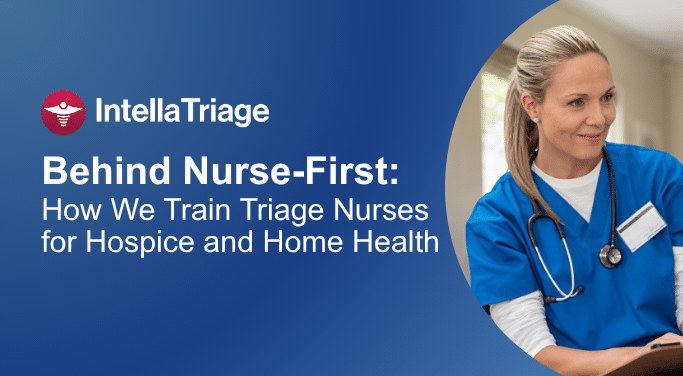
Nursing school doesn't teach telephone triage. A nurse with fifteen years of bedside experience has likely assessed thousands of patients. But when that assessment moves to the phone, visual cues disappear: skin color, breathing effort, positioning, whether the caregiver is "holding it together." A telephone triage nurse must rebuild that picture using questions, active listening, [...]

A hospice or home health nurse arrives for a scheduled patient visit. Then their cell phone rings with a medication question, a scheduling issue, a caregiver concern... a call that needs to be routed elsewhere. Individually, each type of interruption may seem manageable. Across an entire care team and multiple scheduled visits, they add up [...]

Every triage vendor can hand you a feature list, and most of them overlap. Twenty-four-seven coverage. EMR access. Reporting dashboards. HIPAA compliance. Line the sheets up side by side, and the vendors start to look interchangeable. They aren't. The feature list is just the wrong instrument for telling them apart, because while standard features describe [...]
The best patient engagement often shows up in what doesn't happen. A caregiver doesn't reach the point of panic before seeking help. A change in pain or anxiety doesn't go unnoticed between visits. A medication question doesn't become an after-hours crisis. A family doesn't begin questioning the hospice plan of care because they feel unsupported. [...]
After-hours calls are often treated as individual events. Medication questions or symptom concerns come through, are documented and resolved, then the organization moves on. Therein lies the issue: when those calls are viewed separately, as individual instances only, agencies miss the bigger story. Every after-hours call is a data point. When considered collectively, these calls [...]
For many home health and hospice leaders, the cost of after-hours triage seems straightforward. You look at who is taking calls, what they are paid, how often they are on call, and whether overtime applies. From there, it feels like a simple staffing equation: Can we cover nights, weekends, and holidays with our own nurses [...]
On May 13, CMS placed a six-month, nationwide moratorium on new Medicare enrollments for hospice and home health agencies. Existing providers can keep operating and keep serving patients. New agencies, new locations, and certain ownership changes are on hold, and the pause can be extended in six-month increments. While established agencies might view this period [...]
For after-hours triage services, nurse triage models and medical call centers may sound like similar solutions, but what may seem like small operational differences are highly significant for clinical outcomes. A medical call center or answering service is usually designed to answer, document, and route calls. A nurse-first triage model is designed to assess, resolve, [...]
Many hospice organizations already call patients and families between scheduled visits. But there is an important difference between making a check-in call and creating a meaningful clinical touchpoint. A routine call may confirm that everything is "okay." A clinical call can uncover a change in pain, medication adherence, caregiver stress, anxiety, or confidence in the [...]
Consistency is the standard every home health and hospice organization strives for, yet it is often the first thing to break down after hours. Not because patients are more complex at night, and not because nurses are less capable, but because the systems surrounding those moments are rarely designed to support consistent clinical decision-making under [...]
After-hours care isn't where hospice and home health organizations intend to underperform, but it's often where variability first shows up. All things considered, it's not because teams aren't committed or because nurses lack expertise. Chiefly, it's because most after-hours models are built around coverage, not design. And there's a difference. Coverage Keeps the Lights On. [...]