The #1 Provider of Nurse-First Triage Solutions
For most healthcare organizations, triage is often the weakest link in the care chain. Patients wait. Nurses get called off visits or awoken in the middle of the night. Documentation is inconsistent. And the unpredictable nature of triage calls makes staffing difficult.
IntellaTriage fixes this with licensed nurses who answer in 37 seconds on average, proven Schmitt-Thompson protocols customized to your agency, and real-time documentation delivered directly into your electronic medical record system. The result: better patient outcomes, nurses who can actually rest, and an operational infrastructure that scales as your census grows.
We’ve been doing this since 2008, and we’ve spent nearly two decades becoming the experts in hospice and home health triage and nurse advice lines.

Triage Strategies Customized To Fit Your Needs
Nurse-first triage ensures patients are immediately connected with a licensed nurse for guidance, reducing wait times and relieving field clinicians’ burden. Access to nurse-first triage has been proven to improve patient and clinician satisfaction.
At IntellaTriage, we partner with hospice and home health agencies, health plans, and even large physician groups to enhance the patient and caregiver experience, prevent nurse burnout and turnover, and improve financial performance. Our nurses deliver clinically informed, compassionate triage care via custom protocols and direct access to electronic medical records.
A Tailored Approach to Compassionate Care
As an extension of your team, we use a tailored approach to triage while delivering compassionate clinical expertise through licensed nurses.
Every IntellaTriage engagement begins with your protocols, your EMR, and your patients. Our nurses are onboarded to your agency to eliminate any gap in care quality between your team and ours.
Our nurses are trained in telephone triage based on the foundational Schmitt-Thompson triage guidelines. We work with your organization to customize protocols and procedures that work for you. And with our leading-edge technology, we provide the best possible on-call patient experience for hospice and home health facilities and providers nationwide.

Unparalleled Service for Your Patients, 24/7
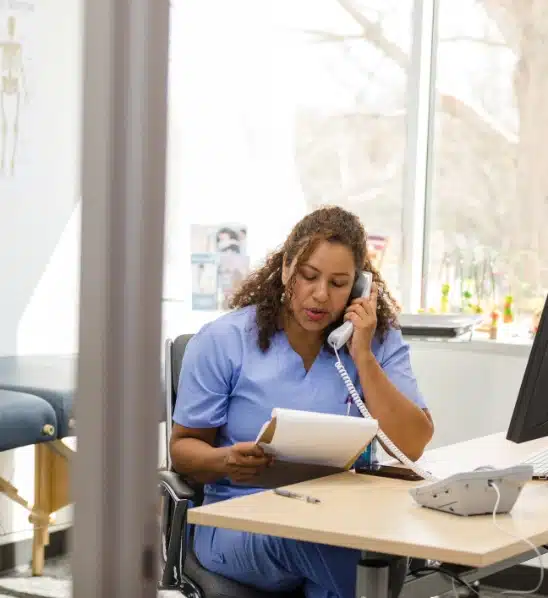
Our team of licensed, trained triage nurses provides a variety of solutions to support your organization. By partnering with us, you can offer 24/7 telephone hospice triage, home health triage, and a comprehensive nurse advice line. Your patients will speak directly to a nurse within an average of 37 seconds. We also provide patient engagement services for post-discharge follow-up. When you work with IntellaTriage, your patients’ calls are answered quickly and knowledgably, ensuring seamless and effective access to care.
Trusted Coast-to-Coast
We are proud to be the nation’s leading provider of licensed, nurse-first triage solutions. With our fully integrated, customizable approach to clinical directives, our team of triage-trained nurses sets us apart from other triage companies, establishing us as a trusted partner for hospice and home health organizations across the United States.

Common Questions:
What is nurse-first triage? Nurse-first triage is a triage care model in which every incoming call is answered directly by a licensed nurse, not an operator, not a receptionist, not an automated system. The nurse performs a clinical assessment, provides guidance, and determines the appropriate next step: resolution over the phone, dispatch of a field clinician, or necessary escalation. Nurse-first models consistently outperform nonmedical operator-first models on first-call resolution, patient satisfaction, and clinical safety.
What is after-hours triage? After-hours triage is the clinical process of receiving, assessing, and responding to patient or caregiver calls outside normal business hours. In hospice, home health, and PACE, after-hours coverage is a regulatory requirement and a core component of the patient experience. Quality after-hours triage requires licensed nurses, structured protocols, reliable documentation, and clear escalation pathways.
What does good after-hours triage look like? Good after-hours triage means a live, licensed nurse answers quickly (ideally within minutes), assesses the clinical situation, provides evidence-based guidance, documents the interaction, and routes the call appropriately. It’s not a message-taking service. It’s not a nurse on the couch juggling their own patients. It’s a dedicated clinician who is calm, focused, and fully present for that caller. The best triage also closes the loop: the field team sees what happened overnight before the morning shift begins.
What is the difference between a triage platform and an answering service? An answering service takes messages and routes calls. A triage platform supports licensed nurses in performing clinical assessment, documentation, and decision-making. The difference matters enormously in a hospice or home health context, where the person on the other end of the line may be in crisis, and the response needs to be clinical, not clerical. A message taken is not a patient assessed.
What is speed-to-nurse? Speed-to-nurse is the time elapsed between a patient or caregiver dialing into a triage line and reaching a live licensed nurse. It is one of the most important operational metrics in triage care, and one of the most direct predictors of caregiver satisfaction. Every minute of hold time or IVR navigation adds to caller anxiety. Best-in-class triage operations target answer times under two minutes.
What is first-call resolution? First-call resolution is the percentage of triage calls that are fully resolved during the initial contact, without requiring a callback, a field dispatch, or a follow-up call. It is a measure of both clinical efficiency and triage quality. High first-call resolution means callers are getting their needs met the first time they call, which reduces burden on field staff, reduces caregiver frustration, and lowers overall after-hours cost.
What is telephonic triage? Telephonic triage is the process of clinically assessing a patient’s condition and determining the appropriate level of care entirely over the phone. It requires structured questioning, active listening, application of evidence-based protocols, and the ability to make sound clinical judgments without visual examination. When done well, telephonic triage is both safe and efficient. When done poorly, or by non-clinical staff, it creates serious risk.
Can outsourced triage improve nurse retention? Yes – and the data increasingly supports it. When field nurses are freed from after-hours call duty, job satisfaction scores improve, and turnover rates drop. Nurses who know their evenings and weekends are protected are more likely to stay. Given that the cost of replacing a single nurse is estimated at $40,000-$60,000, the ROI of reducing turnover through better call management is significant. The same is shown for outsourced triage coverage during the day: Nurses who know their time spent at a patient’s bedside will remain largely uninterrupted report higher job satisfaction and lower burnout.
What is the ROI of nurse-first triage? ROI on nurse-first triage comes from several places that agencies often undercount. The visible savings: reduced unnecessary field dispatch (each avoided visit saves $150-$400+ in mileage, nurse time, and overtime) and reduced nurse turnover (replacing a nurse costs $40,000-$60,000). The less visible savings are just as real: reduced administrative burden on leadership. Running an internal after-hours operation means management standups, technology oversight, vendor coordination, staff scheduling, QA review, and the ongoing overhead of maintaining physical infrastructure, office space, equipment, and connectivity. When triage is outsourced to a purpose-built partner, that entire administrative layer transfers with it. For many agencies, the time leadership reclaims is worth as much as the direct cost savings. Add reduced compliance exposure from better documentation, and the full ROI case is compelling well within the first year.
Contact Us for a Consultation
Ready to optimize your triage process? Reach out to us today for a consultation tailored to your needs. Let’s elevate your patient care together.