The Challenge: Lessen the number of after-hours calls the hospice agency receives regarding medication refills
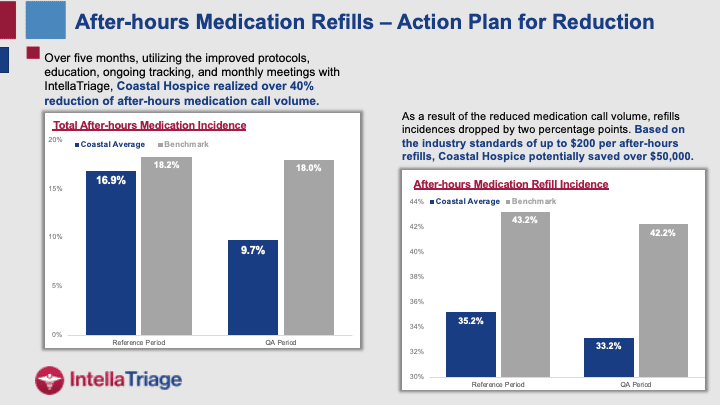
Upon reviewing their after-hours medication refill volume, Coastal Hospice, a long-time partner with IntellaTriage, was determined to be the best-in-class for this metric. The average amount of after-hours calls hospice agencies receive regarding medication is 18.2% of all calls. 43% of those calls are about refills. When calls for medication refills occur after-hours, they directly impact the patient experience. The lack of communication can result in lower CAHPS scores for questions surrounding medication management and getting timely help. In addition, after-hours medication refills can cost up to $200 per refill. At the beginning of this process, medication calls made up an average of 16.9% of Coastal Hospice’s after-hours triage-addressable calls.
Solution: Using IntellaTriage data, clinical directors implemented education and quality improvement measures
Coastal Hospice clinical leaders met with IntellaTriage, who manages their after-hours triage. Together, they determined which metrics would help move the needle toward their goal. IntellaTriage technology collects data on all nurse-triage interactions. To illustrate the best picture of after-hours processes, the team filtered the data by day of the week, time of day, and Coastal Hospice agency locations. Armed with this information, clinical directors implemented education and quality improvement measures to ensure case managers and clinicians addressed medication information and refills during business hours and in the home where applicable.
Our partnership with IntellaTriage to improve patient care services has been amazing. We used data provided by IntellaTriage platform to identify key areas to improve care. Most recently, we addressed after-hours medication refill requests by raising awareness and educating the clinical teams, resulting in significant positive outcomes.
Stacy Cottingham, PhD, RN, CHPN, Chief Clinical Officer at Coastal Hospice
Result: Over 40% reduction of after-hours medication call volume
Over five months, Coastal Hospice utilized the improved protocols, education, ongoing data tracking, and monthly meetings with IntellaTriage. The hospice agency improved from 16.9% to 9.7% on average of all after-hours calls relating to medication – a 40% reduction. As a result, patients experienced better care, and the majority never had to call after hours about their medicine. Additionally, based on the industry standards of up to $200 per after-hours refills, Coastal Hospice potentially saved over $50,000. Unfortunately, many hospice agencies don’t or can’t track what happens during after-hours. But an understanding of the frequency and make-up of calls can inform clinical teams to take action and meaningfully improve daytime practices, resulting in better patient care and decreased medication costs.
Intellatriage
IntellaTriage offers qualified nurse triage services for hospice and home health. Our 24/7 triage services are provided by a team of licensed, registered nurses. We ensure that your patients receive top-quality care at all hours: day or night.
Our team becomes an extension of your own. By using gold-standard protocols and recording interactions in your EMR, IntellaTriage’s nurses address up to 80% of concerns with home care recommendations. This elite level of care is just one phone call away, meaning that while your patients’ issues are addressed, your nurses can focus on other tasks.
Transform your after-hours model. Contact IntellaTriage for a complimentary consultation.
Contact Us for a Consultation
Ready to optimize your triage process? Reach out to us today for a consultation tailored to your needs. Let’s elevate your patient care together.
More From The Blog

A hospice or home health nurse arrives for a scheduled patient visit. Then their cell phone rings with a medication question, a scheduling issue, a caregiver concern... a call that needs to be routed elsewhere. Individually, each type of interruption may seem manageable. Across an entire care team and multiple scheduled visits, they add up [...]
Every triage vendor can hand you a feature list, and most of them overlap. Twenty-four-seven coverage. EMR access. Reporting dashboards. HIPAA compliance. Line the sheets up side by side, and the vendors start to look interchangeable. They aren't. The feature list is just the wrong instrument for telling them apart, because while standard features describe [...]
The best patient engagement often shows up in what doesn't happen. A caregiver doesn't reach the point of panic before seeking help. A change in pain or anxiety doesn't go unnoticed between visits. A medication question doesn't become an after-hours crisis. A family doesn't begin questioning the hospice plan of care because they feel unsupported. [...]