Alongside much of the industry, UNC Continuing Care Services, a prominent North Carolina home health and hospice organization, struggled with maintaining and recruiting nurses until they began to think about their after-hours triage strategy in an entirely new way. Discover how outsourcing after-hours triage and engaging in targeted best practices resulted in a significant turnover reduction for the agency, including during the pandemic.
The Story
In the months before the pandemic, after-hours on-call was becoming a significant dissatisfier for the nursing staff at a large southern home health and hospice agency and was becoming impossible to staff.
Leadership at UNC Continuing Care Services understands that patients calling with important questions require the full attention of the hospice agency – the advice they receive could be life-changing. Reaching a nurse who is preoccupied can negatively impact their experience. Routing calls directly to hospice nurses in the field also affects the patient and family members currently being visited. Patients cannot receive their nurse’s undivided attention, which may result in errors, issues, or negative feelings about their experience. UNC Continuing Care Services began seeking solutions to ensure they provided the best possible access to care after-hours.
The Solution
The agency considered several options to alleviate the on-call burden on their staff. They chose to outsource after-hours triage to reduce turnover and subsequent financial impacts.
The Impact
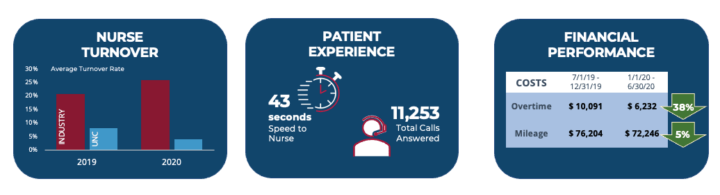
Even during the pandemic, the agency outperformed the home health and hospice industry in turnover and improved its financial performance.
“Patients who are calling with important questions require the full attention of the hospice agency – the advice they receive could be life-changing. Reaching a nurse who is preoccupied can negatively impact their experience. Routing calls directly to hospice nurses in the field also affects the patient and family members currently being visited. They cannot receive their nurse’s undivided attention, which may result in errors, issues, or negative feelings about their experience. The on-call nurses can sleep at night; they are not worried about their cell ringing for non-triage causes.” – Barbara Knott, VP of Continuing Care Services, UNC.
Before/After IntellaTriage After-Hours Comparison
After partnering with IntellaTriage for outsourced triage service, UNC Continuing Care Services reduced nurse turnover against themselves and the rest of the industry. In addition, leadership eliminated sign-on bonuses (for roughly 12 months), reduced overtime and mileage, and improved recruiting costs. Across the customer population, UNC significantly outperformed the market while helping their nurses spend focused time in the home, reducing compassion fatigue and burnout.
Improved Staffing
- Recruited & retained better talent
- ONE voluntary turnover in 2020 (!)
- Eliminated biggest RNCM dissatisfier: on-call
Improved Care
- Increased first-call resolution
- Shorter time to nurse
- More consistent triage
- Field nurses more ‘present’ in the home
Improved Costs
- Improved Hard Costs
- Ancillary expenses
- Nurse turnover
- Stopped paying sign-on bonuses
- Improved Soft Costs
- Reduced nurse burnout
- Increased patient satisfaction
Consider the value of outsourcing your triage.
Nurse burnout is not going away, and providers need real solutions to the burnout problem. Providers must start thinking about how to be as efficient with their existing labor as possible since staffing shortages are not going away.
After-hours is too often an afterthought. An under-reviewed area, it actually makes up 75% of the week. How do you approach after-hours? Optimization in this area may be a solution you have not thought about.
Outsourcing can help. Outsourcing your triage to licensed nurses training in remote triage improves nurse and patient experience and financial performance for hospice and home health agencies.
Contact us today for a free consultation.
Contact Us for a Consultation
Ready to optimize your triage process? Reach out to us today for a consultation tailored to your needs. Let’s elevate your patient care together.
More From The Blog

A hospice or home health nurse arrives for a scheduled patient visit. Then their cell phone rings with a medication question, a scheduling issue, a caregiver concern... a call that needs to be routed elsewhere. Individually, each type of interruption may seem manageable. Across an entire care team and multiple scheduled visits, they add up [...]
Every triage vendor can hand you a feature list, and most of them overlap. Twenty-four-seven coverage. EMR access. Reporting dashboards. HIPAA compliance. Line the sheets up side by side, and the vendors start to look interchangeable. They aren't. The feature list is just the wrong instrument for telling them apart, because while standard features describe [...]
The best patient engagement often shows up in what doesn't happen. A caregiver doesn't reach the point of panic before seeking help. A change in pain or anxiety doesn't go unnoticed between visits. A medication question doesn't become an after-hours crisis. A family doesn't begin questioning the hospice plan of care because they feel unsupported. [...]