Why Nurse-First Care Will Always Matter More
We are drawing a line in the sand. No. AI cannot accomplish everything.
Sure, you could let AI answer your after-hours calls. But ask yourself: why would you want to if you don’t have to?
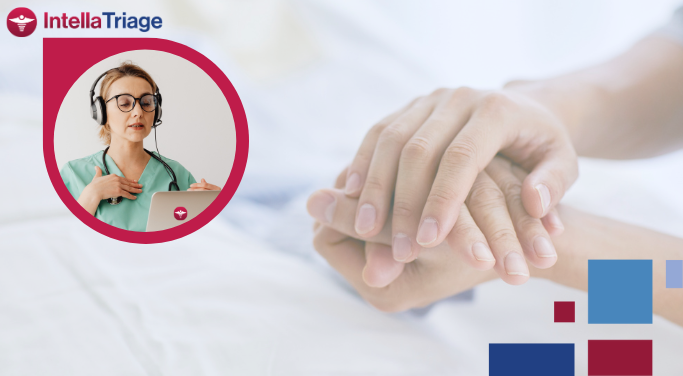
On the other end of that phone is not just a “call” — it’s a worried spouse, an anxious adult child, or a patient in pain. These callers don’t want an automated script. They don’t need a chatbot. Patients and caregivers need a human. That’s why the best after-hours strategies put licensed, experienced, compassionate nurses at the center.
Technology plays a vital role, but its job is to clear the path, not replace the caregiver. Increasingly, the best solutions across multiple industries are putting a “human in the middle.” At IntellaTriage, we are actually putting them first – at the front of the solution. This has always been our philosophy: technology is a powerful tool, but when a patient or family member is in distress, nothing replaces the compassion and expertise of a nurse. That is what “nurse-first” truly means.
Scalable Nurse Triage in Hospice and Home Health
We understand the workforce realities: most agencies lack the resources or budget to staff overnight shifts with sufficient nurses for rapid engagement. That’s why after-hours triage matters.
The industry has evolved from spreadsheets and voicemail to scalable, integrated platforms capable of handling 800,000+ calls a month. But data and software don’t solve the core problem. A patient can’t be comforted by a dashboard. They need a nurse.
Our own metrics show our patients and families reach an IntellaTriage nurse in 37 seconds on average. Compare that to the 30–60 minutes that many agencies still ask families to wait for a callback: a delay that often leads to ER visits, poor outcomes, or, worst of all, families feeling abandoned.
Nurse-First Triage and Technology in After-Hours Care
AI is fast. But fast doesn’t always mean better. Research from the CMS CAHPS Hospice Survey shows that timely communication and compassionate interaction are among the strongest predictors of family satisfaction.
What technology and AI can do – and what platforms like IntellaHub are designed for – is everything around the nurse:
- Instantly identify the patient and agency branch
- Surface recent triage interactions
- Populate EMRs in real time
- Close the documentation loop to remove extra steps from field staff later
That’s the correct equation: tech handles the noise, the nurse delivers the care.
Why EMR Integration Is Non-Negotiable
We all know the pain of EMRs that don’t talk to each other. Delays, duplicate work, and gaps in records put patients at risk. Studies in have shown direct links between fragmented documentation and rehospitalization and medication errors (WILEY Online Library, Fragmented care and chronic illness patient outcomes: A systematic review).
Direct integrations eliminate those risks. Nurses receive the necessary information before while they are on the patient encounter call. Families get seamless, safe care. Agencies receive real-time, accurate documentation without the midnight paperwork.
Protecting Nurses Protects Patients
Burnout is not just a buzzword; it’s a crisis. The American Nurses Foundation’s 2023 Survey reported that 64% of nurses felt exhausted or burned out, with the after-hours call burden being a significant factor (American Nurses Foundation Survey, 2023). In hospice, grief layering and the emotional toll of end-of-life care compound that pressure. When nurses burn out and leave, agencies lose not just staff, but also quality, patient trust, and financial stability.
Protecting nurses from unnecessary overnight strain has become a strategic imperative. The new HOPE (Hospice Outcomes & Patient Evaluation) tool underscores this urgency. CMS is making it clear that hospice quality is no longer measured only by processes, but by the patient experience itself. By tracking timeliness of follow-up and responsiveness to symptoms, HOPE elevates what families have always cared about most: fast, compassionate care in moments of need.
The Best Strategy for 2026: Choose Human
As agencies plan for 2026, here’s the truth:
- Yes, you should lean harder into AI.
- Yes, you may need to reconfigure overnight staffing models to save costs.
- The trick is to figure out how
Every metric that matters (patient satisfaction, nurse retention, financial sustainability) improves when patients have fast, compassionate access to a nurse, supported by intelligent technology and seamless coordination. The agencies that will thrive in 2026 will be those that invest in people, not just platforms. Nurse-first triage is how you protect your workforce, elevate patient care, and strengthen your bottom line.
Because at the end of the day, technology may power the process, but it’s the human on the line who delivers the care.
To find out more about how our triage solution can support your home health or hospice agency, reach out today for a consultation.
Contact Us for a Consultation
Ready to optimize your triage process? Reach out to us today for a consultation tailored to your needs. Let’s elevate your patient care together.
More From The Blog

Patient needs don’t end at the close of business. But many care delivery systems still do. In home health, hospice, and palliative care, patients and caregivers experience care as continuous. Symptoms evolve unpredictably. Questions arise outside scheduled visits. Yet many organizations still rely on fragments models that operate after-hours triage care as separately from daytime [...]

Patient needs don’t end with the workday and care shouldn’t either. But sustaining continuous care across all hours is far from simple. The real challenge for home-based care organizations is not in recognizing this truth, but rather in designing systems that can support continuous, clinically sound care across all hours and the full episode of [...]
Post-acute care has been shaped these past years by by workforce shortages, evolving regulatory and payment models, and growing expectations around patient experience. Provider organizations now face a critical inflection point. The decisions leaders make in the next 12 months will materially affect quality care, organizational growth, staff experience, and financial stability for years to [...]