There’s a quiet cost in hospice and home health that rarely appears on a balance sheet. It’s the cost of unresolved work.
- The chart that couldn’t be closed timely.
- The family call that didn’t quite feel finished.
- The repeat caller who calls are not being linked to each other.
- The uncertainty that follows a nurse home.
When clinical access is inconsistent, unresolved work doesn’t disappear. It shifts.
- It shifts to the next shift.
- It shifts to the weekend.
- It shifts to the field nurse walking into a Monday morning with questions waiting.
- It shifts to a re-hospitalization or ED visit.
And over time, it shifts into burnout.
What “Good” Looks Like
What changes when nurses aren’t carrying unresolved work across shifts or overnight?
- Documentation is cleaner and more complete.
- Field staff begin their day with clarity instead of catch-up.
- Families receive consistent guidance instead of variable reassurance.
- Escalations are managed earlier, not reactively.
- Leaders gain visibility into patterns, not just anecdotes.
Consistency in clinical access is a system foundation that protects patients. It also protects cognitive bandwidth for your nurses.
And cognitive bandwidth is one of the most fragile resources in healthcare.
When Continuity Is Visible
Good after-hours care isn’t only defined by answering the phone. It’s defined by resolution, and that involves who answers the phone.
Resolution means:
- The issue was clinically assessed.
- The right level of intervention occurred.
- The care team can see what happened.
- The next nurse isn’t starting from scratch.
When access is consistent, continuity becomes visible.
When continuity becomes visible, leaders can finally ask better questions.
This Is What “Nurse-First” Actually Means
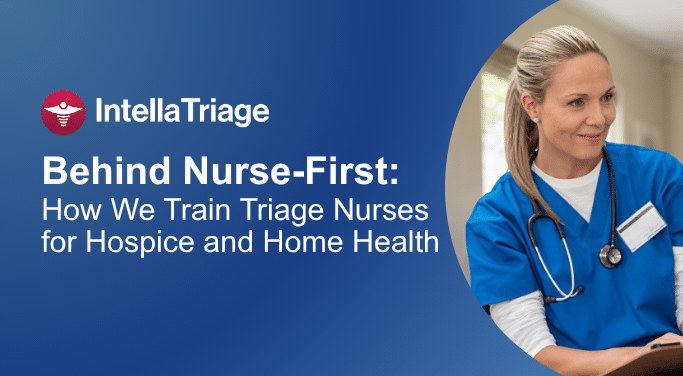
Nurse-first isn’t a tagline. It’s a system design decision we at IntellaTriage have purposefully made.
It means:
- Licensed clinicians answer the phone.
- Sound, clinical judgement manages escalations, not scripts.
- The goal is clinical closure, not call containment.
When you design for resolution instead of volume, the ripple effects extend across the entire organization.
- Fewer loose ends.
- Better quality outcomes.
- Less clinician cognitive burden.
- More energy left for actual nursing.
That’s what “good” looks like. And it’s closer than many providers think.
Is your triage system designed for “good”? We can help. Schedule a 30 minute consultation today.
Contact Us for a Consultation
Ready to optimize your triage process? Reach out to us today for a consultation tailored to your needs. Let’s elevate your patient care together.
More From The Blog

Nursing school doesn't teach telephone triage. A nurse with fifteen years of bedside experience has likely assessed thousands of patients. But when that assessment moves to the phone, visual cues disappear: skin color, breathing effort, positioning, whether the caregiver is "holding it together." A telephone triage nurse must rebuild that picture using questions, active listening, [...]
A hospice or home health nurse arrives for a scheduled patient visit. Then their cell phone rings with a medication question, a scheduling issue, a caregiver concern... a call that needs to be routed elsewhere. Individually, each type of interruption may seem manageable. Across an entire care team and multiple scheduled visits, they add up [...]
Every triage vendor can hand you a feature list, and most of them overlap. Twenty-four-seven coverage. EMR access. Reporting dashboards. HIPAA compliance. Line the sheets up side by side, and the vendors start to look interchangeable. They aren't. The feature list is just the wrong instrument for telling them apart, because while standard features describe [...]