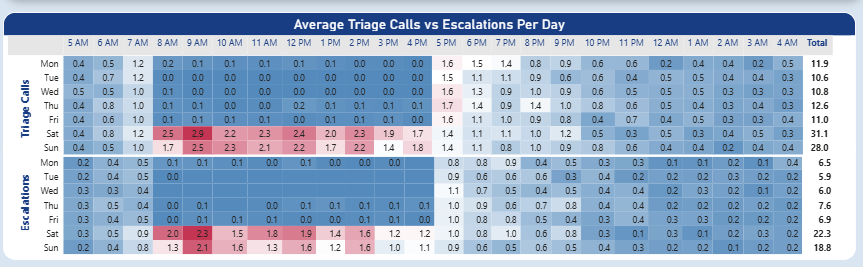
Most triage budgets start with a single number: a cost per call, or the salary of one more on-call nurse. That number hides what drives it. When do calls actually arrive? How many end with a nurse’s guidance instead of a visit? How often does a call pull a clinician out of a patient’s home?
The short version: Before you fund a 2027 coverage model, measure call volume by hour, time to answer, abandoned calls, disposition, repeat callers, and phone resolution rate. Compare them against an outside benchmark and against any vendor’s quote. In IntellaTriage’s 2026 benchmark, the share of encounters closed without notifying the on-call nurse ranged from 48.3% to 87.2% across four cohorts. A gap that wide is why your own number matters.
Disclosure: IntellaTriage published the benchmark report discussed below, and this article draws on it.
What should a hospice include when it prices triage coverage?
Price the whole job, not just the hours. An in-house model has to cover nights, weekends, holidays, and peak periods. It also needs an honest count of what on-call duty costs your daytime clinical work, plus the time spent documenting and routing each call.
If you’re looking at an outside partner, put the fee next to everything else you’ll absorb: service scope, implementation, integration with your systems, and access to reporting. Price both options for the same scope, or the comparison tells you nothing.
Which call measures are worth pulling?
Define each one before you compare any periods or vendors:
- Call volume by hour and day: when demand actually lands.
- Time to answer: how long a caller waits for a person.
- Abandoned calls: callers who hang up before connecting.
- Disposition: what happened. Resolved by phone, escalated, or sent to a visit.
- Repeat callers: the same patient or caregiver calling again within a fixed window you set.
- Phone resolution rate: the share of calls closed without an in-person visit or on-call notification.
If you can, add how often field staff is interrupted during visits and how much follow-up work a call leaves behind.
Write the definitions down. One vendor’s “escalation” may not be yours, and “repeat caller” means nothing until you’ve decided how to identify one.
What does the State of Post-Acute Triage report say?
IntellaTriage’s 2026 benchmark report, covered by Hospice News, gives you outside numbers to compare against. It draws on a benchmark subset of IntellaTriage’s data from July 2025 through June 2026, split into hospice and home health, after hours and business hours. It isn’t an industry census, so treat it as a reference point. [Download the report]([report landing page link]).
Three findings bear on a 2027 budget:
- Phone resolution varies widely. Across the four cohorts, triage nurses closed between 48.3% and 87.2% of encounters without notifying the on-call nurse. If you don’t know your own rate, you can’t tell where you fall in that range, so begin here. Find your current resolution rates and know them.
- Hospice and home health need different coverage. Hospice patients generate after-hours contact at roughly nine times the rate of home health patients, and the work differs. Hospice after-hours calls are mostly medication, change in condition, and end-of-life needs. Home health after-hours calls are mostly scheduling and visit changes. One staffing model for both will fit one of them poorly.
- Hospice repeat-caller rates run nearly double home health’s. Some of that is appropriate high-touch care. The report also treats repeat calling as a possible sign of an unresolved need, which is why you should decide up front how to identify a repeat caller.
Compare each against your own numbers, and note where and why you differ. Patient mix, service area, and operating model all move these figures.
What do your numbers tell you to do?
Match each pattern to a decision:
- Calls bunch into a few hours. You have a coverage-shape question, not necessarily a headcount question.
- One call type keeps ending in a visit. Review the clinical context and your protocol with your clinical lead before you change coverage.
- Repeat callers cluster around certain patients or call types. Look for an unresolved need, such as symptom management or caregiver education, before you treat it as volume.
- Documentation or handoffs run long. Look at workflow and integration before you add people.
The data shows you where to look. Your clinicians decide what it means.
What should you ask about technology?
Technology changes how much work each call creates, so it belongs in the budget. IntellaHub is IntellaTriage’s clinical communication and triage platform. It gives nurses access to clinical information, documentation, reporting, and care-team coordination. Whatever you evaluate, ask three things:
- Does it work with the systems you already run?
- Can leaders get usable reports without an analyst?
- Does the nurse work in one place or two?
What goes in the evidence packet?
Assemble this before anyone approves a 2027 plan:
- Baseline measures and their definitions
- Current staffing and technology costs
- Known constraints
- The service outcomes you won’t trade away
- The industry benchmark, with differences from your data noted
- How leaders will review performance each quarter
Finance will ask what coverage costs. Bring that answer with the call data behind it, the outcomes you’re protecting, and a schedule for checking the plan against reality.
FAQ
What should a hospice budget for after-hours triage?
Start with the cost of covering nights, weekends, holidays, and peak periods, then add the effect on daytime clinical work and the time spent documenting and routing calls. Set the figure after you’ve measured your own call volume by hour, not from a per-call estimate.
What call data should hospice leaders track before budget season?
Call volume by hour and day, time to answer, abandoned calls, disposition, repeat callers, and phone resolution rate. Define each before comparing periods or vendors.
How do you compare in-house triage with an outsourced service?
Price both for the same scope. For an outside partner, include implementation, integration, and reporting access alongside the fee. For an in-house model, include on-call strain and documentation time.
What counts as an escalation in triage reporting?
There’s no universal definition, so write yours down. Decide whether an escalation means any on-call notification, a dispatched visit, or both, and apply it the same way across periods and vendors.
Contact Us for a Consultation
Ready to optimize your triage process? Reach out to us today for a consultation tailored to your needs. Let’s elevate your patient care together.
More From The Blog

Most triage budgets start with a single number: a cost per call, or the salary of one more on-call nurse. That number hides what drives it. When do calls actually arrive? How many end with a nurse's guidance instead of a visit? How often does a call pull a clinician out of a patient's home? [...]

In many home health and hospice agencies, the scheduler, the field nurse, and the clinical leader are each looking at a different version of the day. A call comes in, a message is left in one place, an update follows later somewhere else, and someone has to reconstruct what actually happened. Real-time visibility closes that [...]
Most patient engagement begins when someone reaches a breaking point: A symptom worsens. A caregiver becomes uncertain. Medication is missed. A family calls after hours because they do not know what else to do. While reactive nurse-first triage remains essential to quality care, we cannot overlook getting ahead of issues before they arise. Responding well [...]