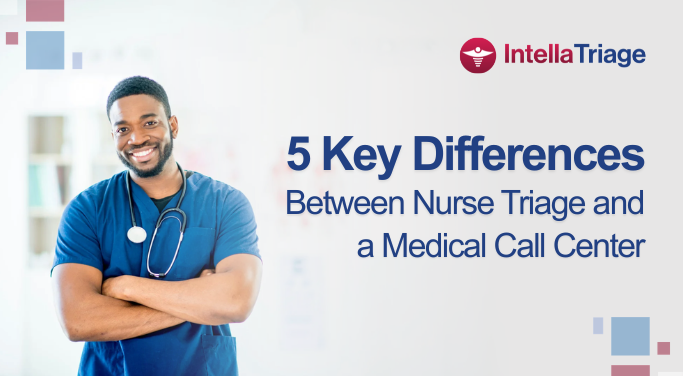
For after-hours triage services, nurse triage models and medical call centers may sound like similar solutions, but what may seem like small operational differences are highly significant for clinical outcomes.
A medical call center or answering service is usually designed to answer, document, and route calls. A nurse-first triage model is designed to assess, resolve, and escalate when appropriate, while supporting continuity of care in real time. This turns fragmented after-hours coverage into continuous care.
That distinction matters because after-hours care is not just a communication challenge. It affects patient experience, nurse workload, clinical escalation, caregiver confidence, and long-term cost.
A medical answering service may appear less expensive up front, but a lower cost often reflects a narrower scope of services. Nurse-first triage is an investment in better patient care. A licensed nurse is directly involved in every encounter, preventing unnecessary escalations, avoidable staff interruptions, delayed support, burnout, and inefficient use of clinical resources. The ripple effects of those costs are what determine the true value of nurse-first triage.
The differences between nurse-first triage and a medical call center go far beyond financial costs, impacting everything from staff retention to patient outcomes. Here are five key differences to keep in mind when assessing which solution is right for your agency.
1. Patient Access to Care
A medical call center can help ensure a call gets answered. But “answered” does not always mean “resolved.”
In call center or answering service models, the first person a patient or caregiver reaches is non-clinical. That person may gather basic information, take a message, and contact the on-call nurse. From the patient’s perspective, that can create a frustrating experience: call, explain the issue, wait, explain the issue again, and hope the right person responds quickly.
Nurse-first triage changes the experience from the very first step. Instead of reaching a message-taker, the caller reaches a licensed nurse who can begin assessing the situation immediately.
While answering services may require a patient or caregiver to wait for a call back from a nurse, IntellaTriage connects them with a nurse in an average of 37 seconds. Patients are not simply getting their call answered quickly; they are getting connected to a nurse quickly.
That distinction is especially important in home health and hospice, where calls often happen during moments of uncertainty: a symptom change, a medication question, a caregiver who is worried, or a patient whose condition feels different than expected.
Patients and caregivers receive faster clinical support at the moment they need it. That is what continuous coverage looks like in practice — the same standard of clinical access at 2 a.m. as at 2 p.m.
2. Empowering Patients and Caregivers to Do More
Patients and caregivers do not always need an in-person visit. Sometimes they need reassurance. Sometimes they need education. Sometimes they need a nurse to help them understand what is happening and what to do next.
A call center can pass along a message. A nurse can assess, educate, and guide, which reduces unnecessary escalation. On average, IntellaTriage nurses resolve 75–80% of triage-addressable hospice issues on the first call and 97% of triage-addressable home health issues on the first call. Less time waiting to receive a call back means less stress and less time experiencing discomfort.
Of course, not every call should stay with the triage nurse. The right escalation at the right time is part of good care. But when calls can be safely resolved by a nurse, agencies protect their local clinical teams from avoidable interruptions and give patients a better experience.
That is the real value of patient empowerment: caregivers get clinically sound guidance sooner, and local teams are preserved for the situations that truly require them.
3. Analytics and Reporting
A medical call center may be able to tell you how many calls came in, how long callers waited, or how many messages were taken. Those metrics can be useful, but they do not always explain what is actually happening after hours.
Nurse triage creates richer operational insight because the interaction is clinical from the beginning. Each call can reveal patterns: symptom issues, medication questions, caregiver education needs, repeat callers, avoidable escalations, and gaps in the care plan.
For home health and hospice leaders, this information can shape better decisions. It can help identify where patients need more proactive education, where staff may be overburdened, and where processes may be creating unnecessary escalation.
This is where nurse-first triage becomes an operational feedback loop rather than just call coverage. Nurse triage produces more meaningful data, because the person documenting the encounter understands the clinical context.
4. Routing to the Right Nurse at the Right Time
In a call center model, routing often means transferring a message to the next person in the chain. In a nurse-first triage model, routing is based on clinical judgment.
Not every call requires the same response. Some calls can be resolved with education; some need follow-up the next day. Some issues may require immediate escalation to the on-call nurse for a home visit. A nurse-first model is built to make those distinctions earlier in the process.
This is also where nurse triage can reduce the hidden cost of after-hours care. When every call gets forwarded to the on-call team, even low-acuity calls consume clinical capacity. Over time, that contributes to fatigue, burnout, and turnover.
By filtering, resolving, and documenting calls that would otherwise require field staff involvement, nurse-first triage can reduce after-hours workload burden by approximately 65%. Each year, IntellaTriage nurses answer more than 1 million calls, resolving up to 80% of caregiver concerns during the initial after-hours interaction and significantly reducing interruptions to local care teams.
Using a conservative estimate of 20 minutes saved per resolved call (including chart review, documentation, coordination, follow-up, and interrupted workflow recovery), outsourced after-hours triage can return an estimated 150,000 nursing hours annually back to direct patient care and other high-value clinical responsibilities.
Nurse-first triage helps ensure local nurses are not used as the default response for every after-hours question. They can be given time to rest and use their time and energy only for responses that require in-person support. This reduces burnout and turnover among field teams so agencies can continue to provide excellent care long-term.
5. Better, More Consistent Patient Experiences
Patient experience is where the difference between call handling and clinical triage is most clear.
A patient or caregiver calling after hours is often already stressed. They may be worried about a symptom, unsure whether something is normal, or afraid of making the wrong decision. Being routed through a non-clinical process can make that moment feel even more fragmented.
A nurse-first model creates a more consistent experience because every call begins with clinical support. The caller does not have to repeat the same story to multiple people before reaching someone who can help.
That consistency can support quality perception, patient trust, and caregiver confidence. It also aligns with the way home health and hospice organizations are evaluated. Hospice CAHPS (Consumer Assessment of Healthcare Providers and Systems) surveys include “Getting Timely Help” as a metric, which reflects an agency’s capacity to provide help as quickly as possible and during evenings, weekends, and holidays. Home Health CAHPS publicly reports whether patients received help or advice and how long it took to receive it when they contacted the agency.
Nurse triage should not be evaluated only in terms of cost or volume of calls answered. It influences the quality, consistency, and sustainability of the care delivered after hours.
Nurse Triage vs. Medical Call Center: Which is Better?
The better option depends on what your organization is trying to solve.
A medical call center or answering service may be enough if the goal is simply to answer calls, take messages, and forward them. It is usually the lower-cost option up front.
But if the goal is to improve after-hours care, reduce unnecessary escalation, support nurses, and create a more consistent patient experience, nurse-first triage is the stronger model.
Nurse-first triage may be a larger investment, but it offers more value: direct access to licensed nurses, clinical assessment, patient and caregiver education, escalation management, and documentation that supports continuity of care.
It’s important to remember that cheaper call coverage can also become more expensive when it leads to more on-call interruptions, delayed support, increased nurse burnout and turnover, avoidable escalation, or poor patient experience.
However, the long-term savings with nurse-first triage are evident across the board. IntellaTriage clients collectively save more than $10 million annually. Health plans can also save by switching from a self-staffed call center to IntellaTriage’s nurse advice line.
The workforce impact is significant. Among home health and hospice agencies that chose IntellaTriage, 88% of nurses reported improved work-life balance, and 96% of clients have said outsourcing with IntellaTriage has helped retain nursing staff.
In a labor environment where replacing a bedside nurse can cost an average of $60,000, retention is not a soft benefit. It is a financial strategy.
For home health and hospice organizations, the question is not only “Who will answer the phone?” It is “What happens after the phone is answered?”
That is where nurse-first triage delivers its value.
Contact Us for a Consultation
Ready to improve after-hours care while protecting your clinical team’s time? Contact IntellaTriage to learn how nurse-first triage can help your organization support patients, reduce avoidable escalation, and make better use of nursing resources.
Contact Us for a Consultation
Ready to optimize your triage process? Reach out to us today for a consultation tailored to your needs. Let’s elevate your patient care together.
More From The Blog

Most patient engagement begins when someone reaches a breaking point: A symptom worsens. A caregiver becomes uncertain. Medication is missed. A family calls after hours because they do not know what else to do. While reactive nurse-first triage remains essential to quality care, we cannot overlook getting ahead of issues before they arise. Responding well [...]
Nursing school doesn't teach telephone triage. A nurse with fifteen years of bedside experience has likely assessed thousands of patients. But when that assessment moves to the phone, visual cues disappear: skin color, breathing effort, positioning, whether the caregiver is "holding it together." A telephone triage nurse must rebuild that picture using questions, active listening, [...]
A hospice or home health nurse arrives for a scheduled patient visit. Then their cell phone rings with a medication question, a scheduling issue, a caregiver concern... a call that needs to be routed elsewhere. Individually, each type of interruption may seem manageable. Across an entire care team and multiple scheduled visits, they add up [...]