Choosing the Right Triage Partner
A Buyer’s Guide for Post-Acute Leaders.
Home-based care doesn’t stop at 5 p.m. Symptoms, questions, and caregiver uncertainty don’t run on business hours, but for most hospice and home health organizations, operational attention, staffing rigor, and quality oversight still do. That mismatch is where clinician burnout, inconsistent triage decisions, and inconsistent patient experience tend to concentrate.
This guide is a practical framework for evaluating (or re-evaluating) an after-hours triage partner. It covers the available coverage models, the criteria that distinguish a strong partner from a weak one, and the questions to ask before you sign. It’s built to be useful whether you’re evaluating IntellaTriage or a competitor.
Why After-Hours Deserves Its Own Evaluation
After-hours coverage makes up roughly three-quarters of the week, yet it’s frequently the least scrutinized part of a care organization’s operations. It is often governed by whichever vendor or on-call structure was in place years ago rather than by a deliberate, current evaluation. A rigorous after-hours strategy isn’t a staffing convenience; it’s a clinical and financial control point that deserves the same scrutiny as any other core service line.
Before evaluating a vendor or considering a model change, it’s worth establishing your own baseline: how quickly calls are currently answered, what percentage of calls are resolved without escalation, and what your abandonment rate is.
Comparison Frameworks
After-Hours Coverage Models
Organizations typically choose among four structural models for after-hours coverage: non-clinical answering services, field nurse staffing with dual triage duty, internal triage teams, and external nurse-first triage. Each carries a different profile across cost, burnout impact, and patient experience.
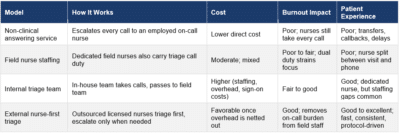
Within the “external triage” category, two sub-models matter and should be explicitly asked about during evaluation:
- “First line of defense” model: after-hours calls route directly to the triage service; only clinically necessary calls escalate to the field/on-call nurse. This is the model that actually relieves burnout.
- “Backup” model: the triage service is only reached if the on-call nurse does not answer. This does not solve nurse burnout, because field nurses still receive the majority of first-touch calls.
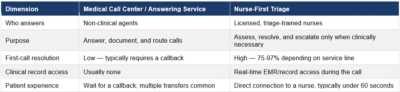
Nurse-First Triage vs. a Medical Call Center / Answering Service
These are frequently confused during vendor selection but are structurally different:
Evaluation Criteria/How to Screen a Vendor Shortlist
A successful selection and implementation process typically takes up to four months. Be sure to build that time into your planning. Before contacting vendors, define what your organization actually needs: coverage scope, protocol approach, EMR posture, and reporting requirements.
- Define Requirements First
- Coverage scope: 24/7, nights and weekends only, or a hybrid schedule?
- Protocol approach: does the vendor use one standard protocol set for every client, or custom-build protocols for your organization?
- EMR posture: does the vendor require deep system integration, lowering the burden on your admin team, or can they work with access-only, lowering the burden on your IT department? (Best vendors offer both options.)
- Reporting needs: what does your leadership team need to see monthly, and who owns reviewing it?
- Background-Check the Shortlist
- Review the vendor’s website for broken links, thin content, or vague service descriptions — often a signal of underdeveloped capability.
- Look for named customer references in case studies and testimonials. Anonymized references (“A Texas Hospice,” “An Ohio Home Health company”) can signal an unwillingness of customers to be named — ask directly for named, callable references.
- Ask how many implementations the vendor has completed and how long they have served organizations like yours (hospice, home health, health plans, health systems). Low implementation counts increase execution risk.
- Red Flags to Halt an Evaluation
- A “one-size-fits-all” protocol model with no willingness to customize to your patient population, religious/ethnic considerations, or care philosophy.
- A home-grown or non-cloud telecom platform, or a vendor unwilling to name their communications carrier.
- Contracted (not employed) nursing staff, or reluctance to share background-check and exclusion-screening practices.
- No named, reference-able customers after repeated requests.
What to Evaluate: Staffing, Training, Technology, Integration, Reporting, QA
The vendor’s staffing model, training approach, and technology stack are where quality actually gets determined. Key questions to run through your shortlist:
- Staffing: Are nurses employed or contracted? Is a consistent, dedicated team assigned to your organization? What clinical/field experience is required? Nurse Triage Best Practices
- Training: What protocol framework are nurses trained on, and is it customized to your organization’s directives or does the vendor mandate its own protocol set as-is?
- Technology: How many points of presence does the telecom platform maintain? What’s the data center uptime commitment? Where, if at all, does AI or automation sit in the call flow?
- Integration: Does the vendor support both native EMR integration and access-only models? Is documentation delivered in real time, or batched?
- Reporting: Can they provide a sample dashboard before you sign? Do they proactively flag patterns, or only report on request?
- Quality assurance: How are individual calls audited? Do findings translate into coaching or protocol revision?
What Good Outcomes Look Like
Organizations that shift to nurse-first after-hours triage typically report measurable improvements across three areas: patient experience (faster response, higher satisfaction with after-hours communication), clinical outcomes (higher first-call resolution, no negative impact on readmissions), and operational cost (reduced overtime, lower unnecessary field dispatches, improved nurse retention).
When evaluating a vendor’s outcome claims, ask for de-identified data from organizations comparable to yours in size and service line, and ask for named, callable references, not just written testimonials.
Contracting, Implementation & Business Continuity
- Implementation & Timeline
- Depending on the size of your organization, ask for a phased implementation plan (many successful transitions, including the CommonSpirit Health at Home case study, are executed in two or more phases to manage risk).
- Confirm realistic timeline expectations — plan for a multi-month selection-to-go-live process, not weeks.
- Ask who owns project management on the vendor side and what your organization’s implementation workload will be (protocol handoff, EMR access provisioning, staff communication).
- Contract & Commercial Terms
- Pricing model: per-call, per-census, subscription/flat-fee, or hybrid — and how pricing scales as census grows or shrinks.
- Contract length, renewal terms, and any exit/transition-assistance provisions if you later change vendors.
- Service Level Agreements (SLAs) for speed-to-nurse, uptime, and escalation response — and what remedies apply if they are missed.
- Business Continuity & Disaster Recovery
- Ask how the vendor maintains coverage during regional weather events, mass casualty events, or infrastructure outages — geographically distributed nurse networks and redundant data centers matter here.
- Ask about surge capacity: how staffing flexes for census growth, seasonal volume, or emergency conditions.
- Scalability & Long-Term Fit
- Ask how the model supports multi-location or multi-state organizations, and whether protocols/reporting can be organized by branch/location as your organization grows.
- Ask whether the vendor offers adjacent services worth evaluating together, such as daytime care team coordination (managing high daytime call volume that similarly displaces field capacity) and proactive patient engagement (structured nurse-led outreach earlier in the episode of care to reduce avoidable escalation).
- References & Track Record
- Request named, callable references from organizations similar in size, service line, and geography to yours, not just written testimonials.
- Ask how long the vendor has served your specific segment (hospice, home health, physician groups, health plans) and how many comparable implementations they have completed.
Master Question List: What to Ask Any Vendor
Model & Coverage
- Is this a “first line of defense” model (calls come to you first) or a “backup” model (calls only reach you if our on-call nurse doesn’t answer)?
- What coverage windows can you support — 24/7, nights/weekends only, or hybrid?
- What percentage of our call volume, based on our census profile, would you expect to resolve without escalation?
Nurse Staffing
- Do you employ or contract your triage nurses?
- Will a consistent, dedicated team of nurses be assigned to our organization?
- What clinical/field experience is required for your triage nurses in our service line (hospice, home health, etc.)?
- Do you perform background checks and OIG/exclusion screening, and will you share findings for the specific nurses assigned to us?
Training & Protocols
- What clinical protocol framework are your nurses trained on, and how is it customized to our organization’s directives?
- Do you require us to adopt your standard protocols, or will you build/customize protocols around ours?
- How are nurses trained on our EMR and documentation workflow before go-live?
- How do you handle ongoing competency development and protocol updates?
Technology & Security
- How many points of presence does your telecom platform maintain, and what is your data center uptime commitment?
- What communications carrier do you use?
- Are your data centers SSAE 16 certified, SOC II audited, and PCI-DSS certified? Do you hold HITRUST or comparable certification?
- Where, if at all, does AI or automation sit in your call flow — does every call reach a licensed nurse directly?
Integration
- What EMR/EHR platforms have you integrated with, and can you demonstrate live experience with ours?
- Can you support both native integration and access-only models?
- Is documentation delivered to our record in real time, or batched/manual?
- What experience do you have integrating with our DME, pharmacy, and scheduling workflows?
Reporting, QA & Compliance
- Can you provide a sample of your standard monthly/quarterly reporting dashboard?
- How do you identify and flag patterns (e.g., a call category trending above benchmark) proactively, rather than only on request?
- How do you audit individual calls for clinical quality, and how do findings translate into coaching or retraining?
- How do our nurses’ triage decisions stay within our hospice Conditions of Participation / core services boundary?
Outcomes, References & Commercial Terms
- Can you share de-identified outcome data (speed to nurse, resolution rate, patient satisfaction, turnover impact, cost savings) from organizations comparable to ours?
- Can you provide named, callable references — not anonymized testimonials?
- How many implementations have you completed in our service line, and how long have you served this market?
- What is your pricing model, and how does it scale with census changes?
- What is a realistic implementation timeline, and what does a phased go-live look like?
- What are your SLAs for speed-to-nurse, uptime, and escalation response — and what happens if they are missed?
- How do you maintain coverage during regional emergencies, weather events, or infrastructure outages?
- What is your contract length, and what transition support do you provide if we ever change vendors?
Want the full framework including current industry benchmark data, documented ROI figures, and outcome data from comparable organizations — as a reference you can bring into vendor calls?
Contact Us for a Consultation
Ready to evaluate your triage model? Reach out to us today for a consultation tailored to your needs. Let’s elevate your patient care together.