The best patient engagement often shows up in what doesn’t happen.
A caregiver doesn’t reach the point of panic before seeking help. A change in pain or anxiety doesn’t go unnoticed between visits. A medication question doesn’t become an after-hours crisis. A family doesn’t begin questioning the hospice plan of care because they feel unsupported. It is these moments that proactive patient outreach is designed to address.
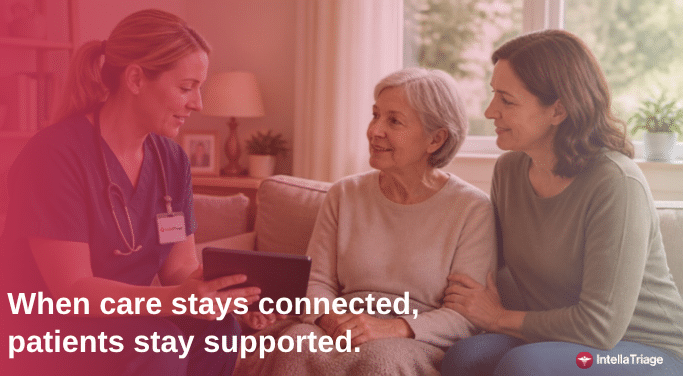
Traditional triage begins when a patient or caregiver reaches out for help. Proactive patient engagement adds another layer of support: a nurse reaches out first, before a concern becomes urgent.
What Is Proactive Patient Outreach in Hospice?
Proactive patient outreach is planned, nurse-led contact with hospice patients and caregivers between scheduled visits. Rather than waiting for the phone to ring, outreach gives the care team an opportunity to identify changing needs, reinforce the plan of care, answer questions, and surface concerns earlier. The important distinction is that effective outreach is about identifying ahead of time which patients may need additional attention, having a clinician make the connection, and ensuring that what is learned leads to the appropriate next step.
Small Changes Can Become Urgent Needs
Hospice patients and caregivers spend most of their time outside scheduled clinical visits. A lot can change during those hours and days.
- A patient’s pain may be getting harder to control.
- A caregiver may be losing sleep and becoming overwhelmed.
- A family may be uncertain about medications or what changes to expect as a patient approaches end of life.
- A newly admitted patient may understand the care plan during the visit but have questions once the clinical team has left.
None of these concerns necessarily begins as a crisis. But without an opportunity to identify and address them, uncertainty and symptoms can escalate. Proactive outreach creates another chance to intervene earlier.
The Right Patient at the Right Time
A scheduled check-in can be helpful. But calling every patient on exactly the same cadence doesn’t necessarily put clinical attention where it is needed most. However, risk-stratified outreach takes a different approach.
With risk-stratified outreach, patient factors such as diagnosis, rehospitalization risk, recent clinical activity, time since contact, and an agency’s own protocols can help prioritize outreach so higher-risk patients receive attention first. That turns outreach from a call schedule into a clinical strategy. Instead of asking, “Who is due for a call?” the organization can ask, “Who may need a nurse today?”
Why the Person Making the Call Matters
Technology can help identify patients for outreach and provide nurses with the information they need. But technology should support the clinical interaction rather than replace it. When a licensed nurse makes the call, the conversation can go beyond confirming that everything is “fine.”
A nurse can explore issues such as:
- Changes in pain or symptoms
- Anxiety or restlessness
- Medication adherence or questions
- Caregiver stress
- Understanding of the plan of care
- Changes that may indicate end-of-life needs
Just as importantly, a nurse can listen for what may not be stated directly. A caregiver saying, “We had a rough night,” may be describing far more than a difficult evening. Clinical judgment helps determine which questions need to come next.
From Outreach to Action
Finding a concern is only the beginning. For proactive engagement to become part of clinical care, there must be a clear path from identification to action.
When outreach uncovers a new or worsening concern, that may mean escalating the issue to the on-call or field team, evaluating whether a visit should occur sooner, or providing additional clinical guidance and caregiver support. The interaction should also become part of the patient’s clinical record. Real-time EMR documentation helps ensure the field team knows what happened during the outreach call and has current information available before the next patient visit. That creates continuity between the nurse making the proactive call and the clinicians providing care in the home.
Proactive Engagement and Triage Work Together
Proactive patient engagement doesn’t replace nurse triage. They address two different moments in the patient experience.
- Triage is reactive: the patient or caregiver identifies a need and calls for help.
- Patient engagement is proactive: a nurse initiates contact before the patient or caregiver needs to make that call.
Together, they help create a more continuous clinical presence between visits. This continuity provides families with access to a nurse when they need help while also creating opportunities to identify concerns before they become urgent.
The Overall Goal Is Fewer Surprises.
The value of proactive outreach shouldn’t be measured simply by how many calls an organization makes. A stronger question is what those calls help uncover, and second to that is how many crises did the outreach calls prevent.
- Did the nurse identify a symptom change earlier?
- Did a caregiver receive support before becoming overwhelmed?
- Did the team learn that a patient needed additional attention?
- Did the next field clinician have better information because the outreach was already documented?
Those are the moments that turn patient engagement from another communications task into an extension of clinical care.
Because sometimes the most important call isn’t the one your team answers. It’s the one a nurse makes before the patient ever needs to call.
Extend Clinical Support Between Visits
IntellaTriage Patient Engagement Services combines licensed-nurse outreach, risk-based prioritization, clinical assessment, escalation, and real-time EMR documentation to help hospice organizations stay connected with patients and caregivers between scheduled visits.
Learn more about Patient Engagement by IntellaTriage and how proactive nurse outreach can complement your existing care model.
Contact Us for a Consultation
Ready to optimize your triage process? Reach out to us today for a consultation tailored to your needs. Let’s elevate your patient care together.
More From The Blog

Most patient engagement begins when someone reaches a breaking point: A symptom worsens. A caregiver becomes uncertain. Medication is missed. A family calls after hours because they do not know what else to do. While reactive nurse-first triage remains essential to quality care, we cannot overlook getting ahead of issues before they arise. Responding well [...]
Nursing school doesn't teach telephone triage. A nurse with fifteen years of bedside experience has likely assessed thousands of patients. But when that assessment moves to the phone, visual cues disappear: skin color, breathing effort, positioning, whether the caregiver is "holding it together." A telephone triage nurse must rebuild that picture using questions, active listening, [...]
A hospice or home health nurse arrives for a scheduled patient visit. Then their cell phone rings with a medication question, a scheduling issue, a caregiver concern... a call that needs to be routed elsewhere. Individually, each type of interruption may seem manageable. Across an entire care team and multiple scheduled visits, they add up [...]